Friday, February 22, 2019

Banality


Visiting the S21 killing fields in Phnom Penh, Cambodia is sobering. A holocaust that the West was complicit in and silent about to this day. Between 1975 to 1979, 1.7 to 3 million Cambodians were executed, some 25% of the population were wiped out by a paranoid and delusional cabal headed by Pol Pot. A name Saloth Sar gave himself as a nom de guerre,  similar to the rites of passage of buddhist monks when they are given a new name. Saloth Sar gave himself this name and renamed all those in his cadre of the Khmer Rouge. 

After visiting the killing fields, which originally was a peaceful ancient Buddhist Chinese cemetery,  I went on to tour the interrogation compound at Tuol Sleng Genocide Museum. The structure is eerily still reminiscent of the high school it once was. Rows of classrooms along a corridor with metal guard rails for windows. The yellow and white ceramic floor tiles reminiscent of my early schools in Malta, perhaps the same French tiles. Of course now the only vestige remaining is of the time when it was used as an interrogation prison under the Khmer Rouge (1875-1979). Photographs of faces of the detained and later to be executed prisoners lining rows upon rows of the walls of the compound. All staring with disbelief that their life has taken such a quick turn. Some young, some old, men, women, children. An equitable selection, no discrimination. And the thought that kept cropping up is how can this have happened out in the open? The compound is smack in the center of Phnom Penh, the largest city (then and now) in Cambodia. And not just the locals who turned a blind eye, the Khmer Rouge held United Nations status even after being overthrown (by the Vietnamese). Khmer Rouge even received funding from the U.N. after this known holocaust. Where is the indignation? And then I learned a little bit more of the history and the pieces started coming together.

Pol Pot and his cadre gained prominence because the population were desperate, angry, frightened and starving. The illegal and unauthorized (by Congress)  USA bombing of Cambodia, the social and economic fabric was  further destabilized, following decades of brutal and corrupt governance. An impoverished populace become desperate.  The US had dropped more than 500,000 tons of bombs on Cambodian, while propping up the corrupt and incompetent anti-communist regime of Marshal Lon Nol who in a coup d'etat eventually stole power from absent Prince Sihanouk (whose son is now King of Cambodia). Within this fertile anger rose a timid and shy teacher.  Pol Pot rose from being a simple teacher to a savor of the Cambodian people. He promised hope for the mostly illiterate farming community, who have been left out of what little progress was made in the cities. He promised a time of greatness when the Khmer nation was strong. When Khmer was a sovereign power that at the peak of its power in the thirteenth century had ruled an empire stretching from Malaysia to Laos from Vietnam to Burma. He promised Khmer to be first and only. He wanted Cambodia to be self sufficient and independent. He promised to shake up the system and bring equity and make the system fair. Does that sound familiar? And if it does then you can empathize with me when  I realized why we have also been complicit in our silence. We are again going through this cycle of history. We are afraid to admit it because we are again so close to it. This must be the peak (trough?) of the banality of humanity and we are all responsible in our silence.

Oliver Masucci in Er ist wieder da (2015)

There is a film that says this better. The 2015 Look Who's Back, a German film by the director David Wnendt that explores the possibility of Hitler coming back today. The comedy quickly changes into a lesson in history when the character playing Hitler admits that it is not him that brings about change but the people that ask for it. He is simply a product of what the public wants. We are ultimately responsible for the people we elect to govern us. They, the individuals we revere or detest, are simply a catalyst. Willing catalysts.

Which brings us back to the Pol Pot regime and our silence and what it tells us about our current governments. I saw a contraption for waterboarding and immediately was reminded of how the U.S. president Trump approves of this illegal torture and how he spews this opinion not just with impunity but with nonchalance.


As I touched the contraption I had a visceral feeling of how I would react to its torture, and that possibility become real. How easy for someone to put me through that inhumanity, publicly and without remorse. I realized that for some, under my government, they already have experienced this, we are already there. The line between doing and pontificating hatred is being erased. And we sit there complicit in our silence in our fear that at least it was not us. The banality of humankind is a mirror of the depravity that we have the potential to degrade into. It seems so easy. And everyone can be a victim. Cambodia was a homogenous society made up of nearly exclusive Khmer ethnic groups. But the Khmer Rouge found enemies in everyone. People with education were a prime target, people who spoke foreign languages, teachers, doctors, politicians educators, professors, technicians. and journalists (still sounding familiar). They were murdered and all their family as well so there is no option for retribution. Those that were performing the murders were not spared or given special treatment. They also had their families wiped out so that there is no option for them to go back to. The foot soldiers who themselves were mostly illiterate children as young as 9, were left with only one option, to obey. Once we define a group as "the other" we deny them their full humanity.We lose our humanity when someone labels us as an"other. " Then they find it easier to follow through, we are already less (non) human.

There is a tree that summarizes to me the humanity that we lost.   Its a big sturdy Chankiri tree indigenous to Cambodia. When they discovered this killing field and examined the tree, they found hair, brain, bone fragments, blood and sinews, and skin still embedded in the cracks of the bark.


For efficiency and to save on ammunition or equipment, children and babies were swung upside down cracking their skull against the tree.

Today the tree stands there quiet and majestic. A testament to our banality.

Sunday, December 9, 2018

Religion and Constancy

The feast day of Immaculate Conception was yesterday, it also happens to be by birthday which I was named Mario (for Maria.) There is a lot of rituals around this feast day. It is a popular feast because it is the only one in winter. Most feasts take place in summer when they can predict balmy dry evenings. At the height of the feast, at 6pm, the statue of the icon is carried on the shoulders of men out of the alcove in the church and they take a tour of the city. The statue although sculptured from a carob tree, was in 1905 encased in 30 kilograms of silver and other precious metals and gems. Originally sculptured in 1680 by Suor Maria de Domenicis a Carmelite nun (buried int he chapel  of Santa Katerina in San Lawrenz church in the neighboring city of Birgu.)


The hierarchy of the church are there in their fineries, together with the sceptre bearer. The sceptre (known more commonly as a Mace and more accurately as a Stave) defines the authority of the church. It usually rests high on a cabinet in the sacristy where the priests and the altar boys prepare for mass. I love the sacristy. I used to help with early morning mass before heading out to school. I do not remember much, but I loved my time helping with mass. I even entertained becoming a priest, but that is for another time and a much sillier story.


Together with fireworks, a band and a singing couple (a tenor and soprano singing Ave Maria) all to herald the emergence of the statue. With great pomp and circumstances the statue slowly makes it way around the city. Four hours later it re-enters the church and is cocooned again into its resting alcove on the right hand side of the church for another year. Somehow this ritual has been going on for centuries. An annual feast to honor the Immaculate Conception, the patron of the church, was recorded as early as the seventeenth century. 


For the locals, this is a time to visit relatives and have a drink or two. When I was younger this was an excuse to drink beer and buy hotdogs from the many kiosks that line the streets of the city. For me yesterday, the highlight was doing laundry on the roof with the view of the Grand Harbor. This never gets old.


Wednesday, December 5, 2018

My Home Town /Bormla

It is the feast of my home town Bormla on Saturday. The 8th of December which is the feast of the Holy Immaculate Mary aka Virgin Mary aka Jesus's mother. It also happens to be my birthday. Growing up I viewed the celebrations purely solipsist--about me--supporting my misguided belief that everyone was acknowledging my birthday. And a remnant of that hubris still exist today as I walk around the city looking at all the decorations for my birthday.


My family home faces the main church, the parocca (par-oh-cha). A tall narrow house that sports a banner across the street during the feast. They renamed the street from Santa Theresa to the Street of the Pilgrimage after the Pope came through the street in his popemobile.


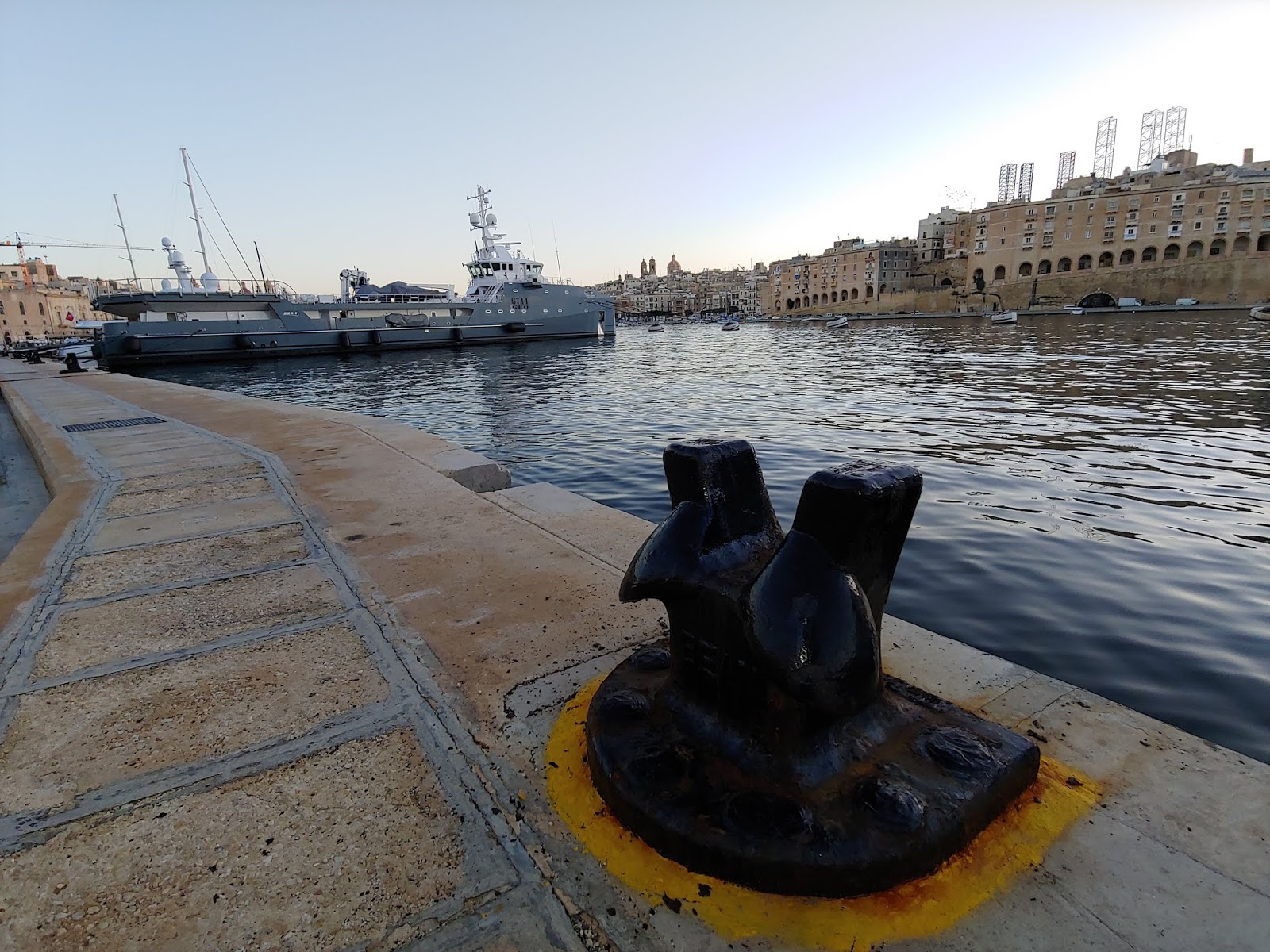
But there are many changes to the city that have nothing to do with the locals. We have multi-million dollar boats moored on the quay of the harbor. Boats that look like multi-storied building on their side. Some are just beyond ostentatious. Take the 6711 Geo. That is the name of the 28 million Euro Netherland-built boat that sits at the end of the dock in Bormla (technically this is part of Birgu). This boat hosts a helicopter, a submarine and all the toys needed to enjoy the sea. It holds all the toys for rich people who are on another yacht at sea. A 28 million Euro toy storage.


There are many incongruities in Bormla and surrounding areas. The three cities that make up part of the Grand Harbou (Bormla, Birgu and l'Isla) share in this character.  But we have always been places of contrasts. The fortifications and palaces that are dotted across the three cities are quiet reminders of past expressions of wealth. Now we have very expensive deluxe apartments, hundreds of multi-million Euro boats and restaurants that cater for the rich.


Monday, December 3, 2018

Passport

I went to renew my Maltese passport today. Needing a witness to verify my renewal my father and I walked across Valletta to another city Floriana to see the Parliamentary Secretary for Planning and the Property Market Chris Agius. Without an appointment he saw us straight away and visited with us for 45 minutes before signing as a witness to my passport application. Only in Malta. We walked back to the passport office with all the documents, signed in less than two hours, including a ferry trip across the harbor and back.


Returning back to Cospicua passing by my apartment in Senglea, a stone throw across the creek (top right hand apartment).


As I left my dad to rest and have an early sample of mum's vegetable soup, I headed out for a walk to get some running shoes from the town of Rahal Gdid. The ostentatious Baroque architecture becomes background noise once you live her long enough. But for visitors, this is a cornucopia of artistic wonders.


Malta is truly an island of Baroque architectural heritage. The influx of both European Union funds to restore older buildings matched with the astronomical inflation of realty prices have converged to revitalize this heritage. There are two stark omissions in the benefits to this growth. House prices have started to become unattainable for the average person and because of all the density and lack of pedestrian walkways it is impossible to get around in a wheelchair. I have seen people in wheelchairs in every city around the world. I have never seen one on the streets in Malta, ever. Even in Mexico City in the underground railway system, although there are no elevators those that use a wheelchair balance on the escalators. No such options exist in Malta as even the escalators tend to be too narrow for such acrobatic proficiencies.

© USA Copyrighted 2018 Mario D. Garrett

Sunday, December 2, 2018

In Search of the Magnificence and Banality of Humankind


In Alighieri Dante’s Divine Comedy we find the intrepid adventurer Ulysses (Inferno XXVI, 90-142) burning in hell while being questioned by Virgil on how he met his death. Ulysses replies that after escaping the clutches of Circe who held him captive in Gaeta, neither the love of his son nor his love for Penelope nor the reverence for his father Laertes could stop him from exploring the world and "to gain experience of the world and of the vices and the worth of men".  Ulysses eventually arrives at his destination an old man. Searching for an answer to what is our humanity, Ulysses risked everything including his life.

Unlike Ulysses I start this journey as an old man (I will reach my 59th in a few days) but I share his quest. To explore the magnificence  and banality of humans. What better way to start from at the beginning, with my family in Malta.


I left Malta when I was thirteen. We moved to England as  a family. My father as part of his duties with the Royal Air Force was "posted" to Hullavington in the heart of the West Country. Five kids ranging in age from 7 to 14 years shepherded by a mother who never flew before. As a motley caravan of immigrants we moved everything of importance in numerous small luggage. We also brought our own food, mainly Maltese bread. The immigration officer was perplexed by the amount of food we each were consciously smugly smuggling in and sneered at my mum as though to insinuate that they also have food in England, only to receive the wrath of my mum's maternal instinct.  He was informed by my mother that Princess Anne, only daughter of Queen Elizabeth II, was marrying Mark Phillips and the grocery shops might be closed in response to the great celebration that such an occasion demands.   Which is how I remember the date...I can google this royal event since our exodus was not otherwise recorded in the annals of history. We each had two bags that we lugged from the airplane onto the minivan that our dad commandeered to drive us to our military camp house stocked full of freshly bought food from the 24/7 supermarket.

Ever since my family moved back to Malta, and I stayed behind in England and  I have been returning every few years to visit. First visiting friends, then visiting home, then visiting family, now visiting parents. For 46 years I have witnessed evolutions not just of geography but also of biology. Increasingly the world of my parents drifts away from the world of the present. This is a good way to start my quest to explore the magnificence  and banality of humans.


© USA Copyrighted 2018 Mario D. Garrett

Sunday, September 10, 2017

Aging In Montclair and bevival present


Aging In Montclair and bevival present

Oct 20-22nd
UP
Cherry Blossoms
Iris
World's Fastest Indidan
Aging in Montclair and bevival.com are proud to present the east coast debut of San Diego’s popular film event, Celebrating Aging In Film. Curated and moderated by series founder, aging expert and author, Professor Mario Garrett Ph.D., this three-day weekend event is designed to shed light on how the aging narrative is transforming our culture.

For film enthusiasts, this weekend educational series is an exciting opportunity to watch four iconic films and participate in illuminating, post-screening discussions with two fascinating educators. Themes include multi-generational relationships, humor, culture, romance, and the enduring creative spirit.
 

Screening venues were made possible through the generosity of Montclair State University, School of Communication and Media, and the Montclair Art Museum.

order your tickets now

Celebrating Aging In Film Series

and VIP Reception
TICKETS + INFO
AIM
Book Group
bevival
Instagram
Copyright © 2017 Aging in Montclair, All rights reserved.
You are receiving this email because you are a member of AIM. Thank you for your support!

Our mailing address is:
Aging in Montclair
13 Trinity Place
The Salvation Army Building
MontclairNJ 07042

Add us to your address book


Want to change how you receive these emails?
You can update your preferences or unsubscribe from this list.